

What Is QuarTeks™? How SPARKX i8 Makes Multicolor 3D Printing Faster
Multicolor 3D printing can transform a simple model into a finished-looking product straight from the build plate. The challenge is that every additional color change can also add time, filament waste and another potential interruption to the print.
That is the problem Creality set out to address with QuarTeks™, the four-color printing technology used by the Creality SPARKX i8.
Instead of repeatedly pulling filament through a long feed path, QuarTeks™ brings four filament channels directly into the hotend. The result is an ultra-short shared filament path of less than 1 mm and color switching in under one second.
In this guide, we look at how the system works, why multicolor printing normally takes so long, and what QuarTeks™ changes inside the SPARKX i8.
Note: SPARKX i8 is currently in the crowdfunding phase on Indiegogo.

Why Does Multicolor 3D Printing Take So Long?
On many single-nozzle multicolor systems, switching from one filament to another involves several separate operations. The active filament has to be cut or retracted, removed from the toolhead, replaced by another filament and fed back towards the nozzle.
The printer then has to make sure the previous material has been cleared from the melt zone before the next color reaches the model. This often requires purging and wiping before printing can continue.
A single change may not look significant. But a detailed four-color model can contain hundreds or even thousands of color changes. Repeating the same loading, unloading and purging process throughout the print can turn a relatively short single-color job into a much longer multicolor one.
That also creates another issue: transition waste. The longer the section of filament shared by different colors, the more material may have to be flushed before a clean color reaches the nozzle.
Different Ways to Build a Multicolor 3D Printer
There is more than one engineering approach to multi-color and multi-material printing. Each solves a different set of problems.
1. Independent Extruders
IDEX systems use separate print heads that move independently along the same axis. Separate filament paths can help prevent different materials from mixing and are useful for applications such as duplication, mirror printing or dual-material work.
The trade-off is additional mechanical complexity, and the architecture is usually focused on two independent toolheads rather than compact four-color printing.
2. Tool-Changing Systems
Another approach is to dock one toolhead and pick up another. Because each tool can maintain its own filament path, tool changing can provide strong material separation.
However, every additional toolhead requires components for extrusion, heating, cooling and positioning. Accurate docking and repeatable alignment are therefore important parts of the system.
3. Hotend-Changing Systems
A smaller variation is to change only the hotend while sharing more of the toolhead hardware. This reduces the amount of hardware that has to move, but the printer still needs reliable heating, sensing, communication and precise positioning for every change.
4. Multiple Filament Paths Inside One Toolhead
For users mainly interested in fast four-color printing with common materials such as PLA, there is another possibility: keep a single motion system, toolhead and nozzle while moving the filament-selection mechanism closer to the hotend.
This is the direction behind QuarTeks™.
What Is QuarTeks™?
QuarTeks™ takes inspiration from a simple four-color ballpoint pen: several colors are already available in one compact mechanism, and the required channel is selected when needed.
Inside the SPARKX i8 toolhead, four dedicated filament channels extend into the hotend. An internal mechanism selects which channel feeds the nozzle, while the printer continues to use the same motion system, extrusion system and hotend.
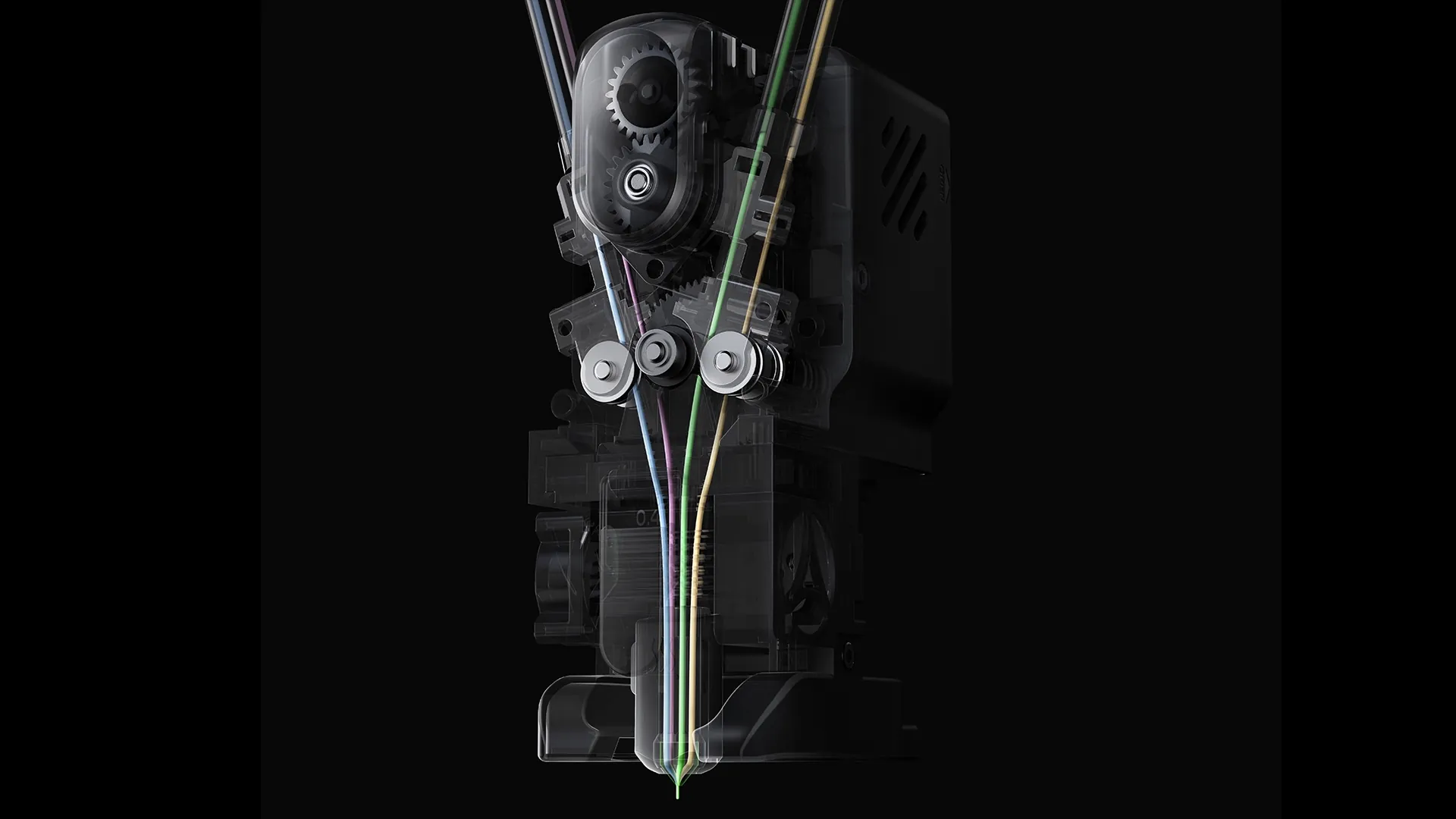
The key difference is how close those four filament paths remain to the nozzle before joining together. QuarTeks™ reduces the shared filament section to less than 1 mm.
That short path is central to both faster switching and reduced flushing.
How Does QuarTeks™ Change Colors?
A normal QuarTeks™ color change can be simplified into four stages:
- The current color finishes its section of the model.
- The internal toolhead mechanism selects the required filament channel.
- The new filament enters the ultra-short shared path of less than 1 mm.
- The system confirms that the selected filament is extruding correctly and printing resumes.
Because the switching action happens inside the toolhead, the printer does not need to pull filament back through a long external route every time the model changes color.
Channel switching takes less than one second, according to Creality's SPARKX i8 specifications.
Why a <1 mm Shared Filament Path Matters
The shared filament path is the section in which material from different channels uses the same route towards the nozzle.
With a longer shared path, more of the previous color can remain between the incoming filament and the nozzle. That material then needs to be cleared before the next visible part of the model is printed.
QuarTeks™ reduces this shared section to less than 1 mm. This means there is much less residual material to displace when the printer changes channels.
As a result, many color transitions can be handled without the large external purge volumes commonly associated with conventional single-nozzle multicolor systems.
Faster Multicolor Printing
Reducing the time required for each change becomes increasingly important as model complexity rises.
Creality Lab testing reports 500%+ faster multicolor printing for SPARKX i8 compared with the previous-generation Creality Hi Combo in the specified test conditions. This figure should not be interpreted as every model printing exactly five times faster: the actual saving depends on the model, number of color changes, materials and print settings.
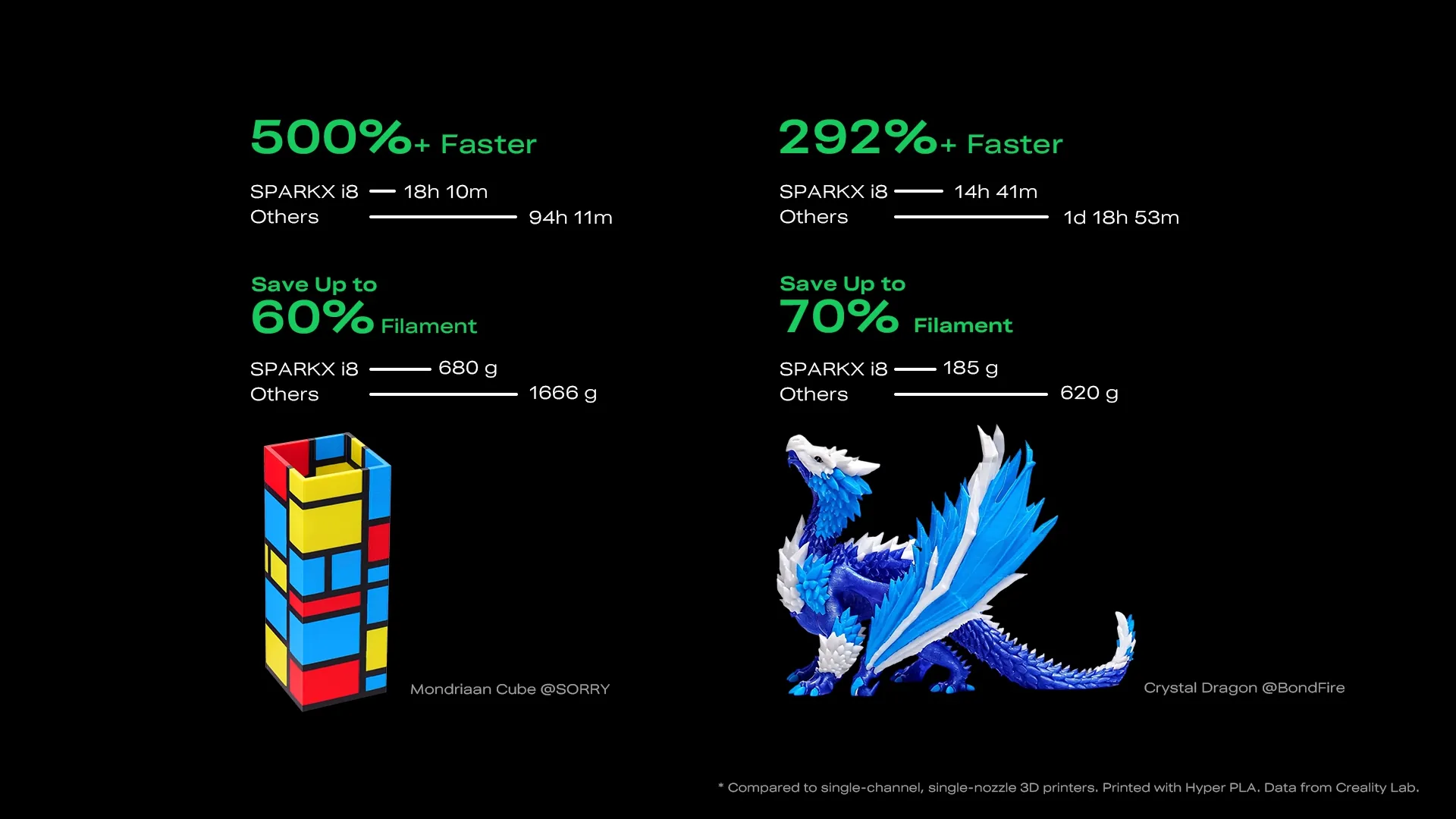
Models containing hundreds or thousands of transitions benefit most because the printer avoids repeatedly spending tens of seconds—or longer—on conventional unloading, feeding and purging cycles.
What Does “Zero Waste” Mean on SPARKX i8?
This point is important to define accurately.
Creality describes SPARKX i8 as capable of zero purge waste during printing in supported printing conditions. It does not mean that the printer can operate indefinitely without ever extruding any material outside the finished model.
A small amount of filament is still flushed during initial preparation. During the print itself, the extremely short shared path greatly reduces the amount of material required for a color transition.
Where appropriate, transition material can also be wiped into internal infill rather than being expelled externally. Creality's slicing strategy uses a defined purity zone so that the transition is completed before the material reaches visible outer walls.
This can allow suitable models to print without a conventional external prime or wipe tower.
How QuarTeks™ Helps Reduce Color Bleeding
Shorter transitions are not only about speed and filament efficiency. They also influence how cleanly one color changes into another.
If a long section of mixed material remains inside the filament path, traces of the previous color can continue to appear after the next filament has started feeding.
With QuarTeks™, the shared section is less than 1 mm. Combined with the hotend design and controlled flushing strategy, this helps minimise residual material and produce cleaner boundaries between contrasting colors.
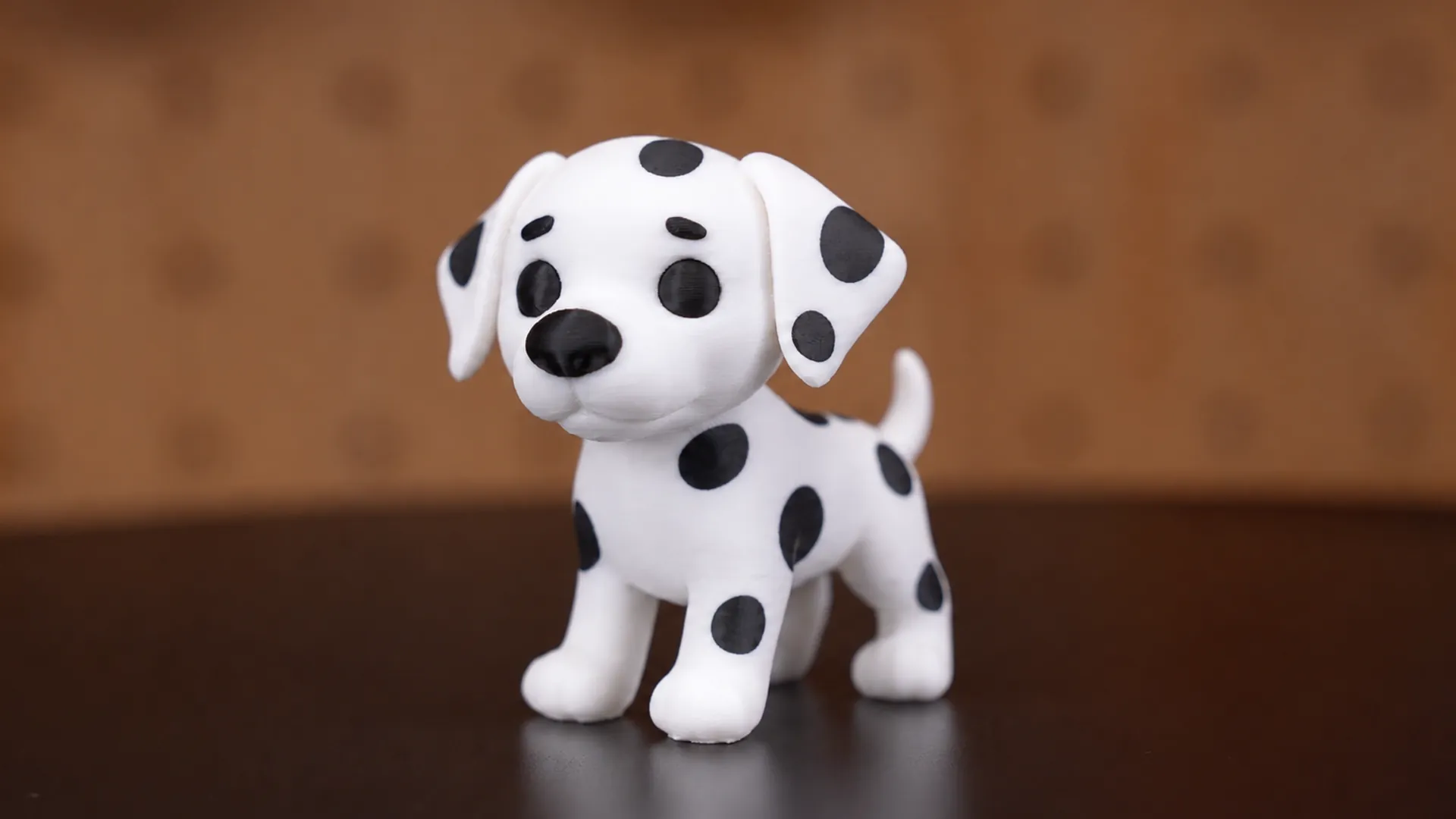
This becomes particularly noticeable on high-contrast combinations such as black and white, where even a small amount of residual material can be easy to see.
Engineering the SPARKX i8 Hotend for Four Filaments
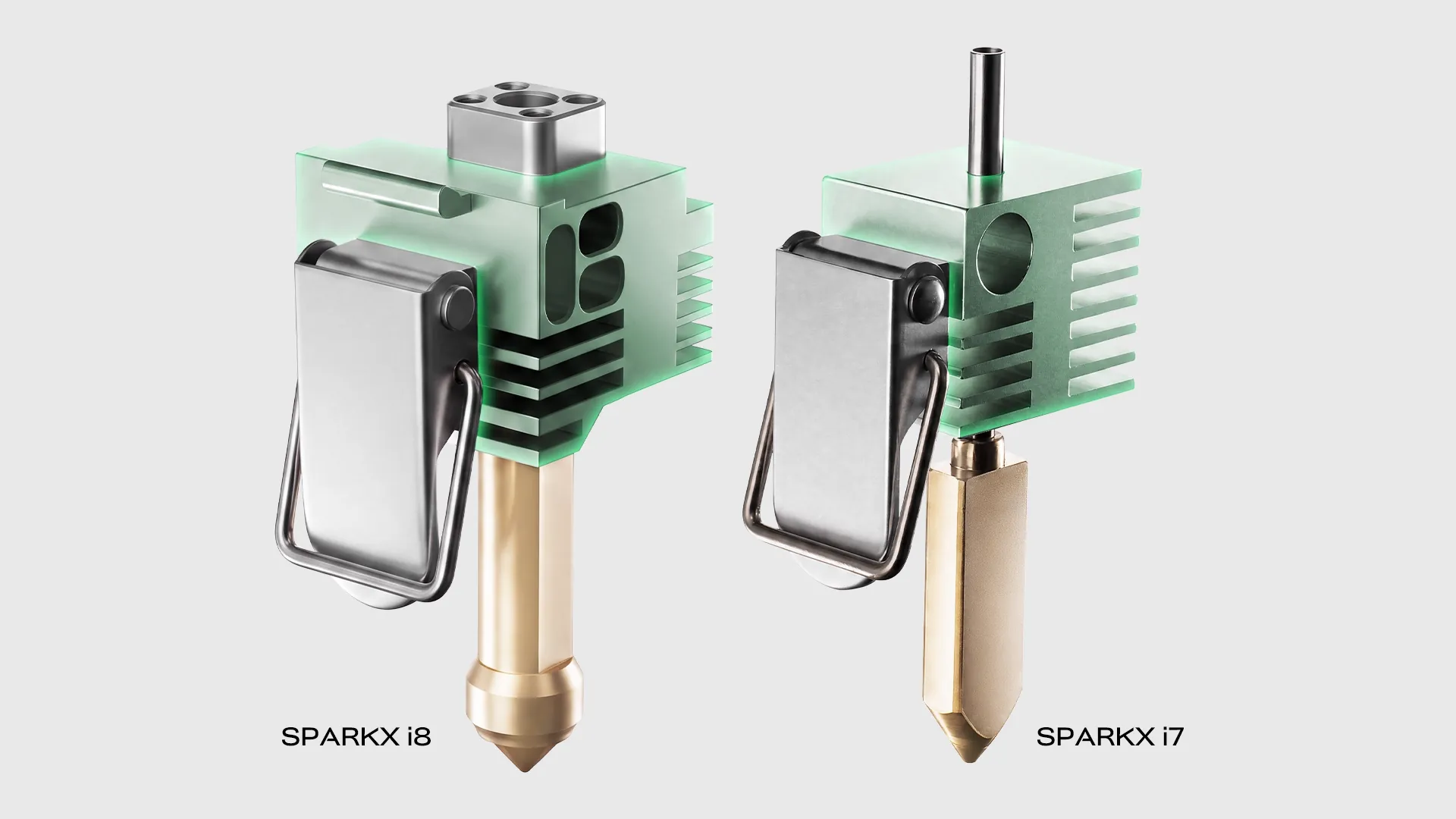
Placing four filament channels close to the melt zone creates its own engineering challenges. Filament that remains close to a hotend for too long can soften prematurely, so thermal control becomes especially important.
The SPARKX i8 addresses this through several hardware features:
- Dedicated toolhead cooling: airflow helps remove heat from the extrusion motors and surrounding components.
- Improved hotend cooling: Creality specifies 50% higher cooling airflow and a heatsink with 100% more surface area than the previous-generation SPARKX i7.
- 70 W high-flow hotend: the quick-swap hotend is rated for a Hyper PLA volumetric flow of up to 25 mm³/s.
- Titanium-alloy heatbreak: designed to limit heat creep into the upper filament path.
- Smart channel cleaning: the system can monitor idle channels and introduce small controlled purges into infill when required.
13 Sensors Monitor the Four Filament Channels
Fast channel switching is useful only if the printer can keep track of what is happening inside the toolhead.
SPARKX i8 therefore integrates 13 intelligent sensors to monitor filament and channel conditions. The monitoring system is designed to help identify issues such as filament runout, slipping, air printing and clogging.
Because QuarTeks™ uses one shared printhead rather than repeatedly exchanging independent tools, it also avoids the XYZ alignment and repeatability considerations associated with multi-toolhead positioning.
Do You Need an External Multicolor System?
The standard SPARKX i8 contains the four-channel QuarTeks™ printhead, so four-color capability is built directly into the printer rather than being created by adding several independent toolheads.
CFS Lite can further automate filament handling with features including RFID filament recognition, automatic loading and unloading and enclosed filament storage.
The two parts therefore serve different roles: QuarTeks™ handles rapid color selection at the toolhead, while the filament system can make spool management more convenient.
Who Is QuarTeks™ Designed For?
The system is particularly relevant if your projects contain frequent color changes and you mainly want to produce multi-color models without spending large amounts of print time and material on transitions.
Typical examples include:
- figurines and decorative models;
- signs, logos and personalised gifts;
- educational models with colour-coded parts;
- batch production of multicolor products;
- models with hundreds or thousands of color transitions.
Material requirements still matter. Different-tool or independent-hotend systems can have advantages when a project requires strong isolation between very different materials or nozzle configurations. QuarTeks™ is instead engineered around making four-color printing faster, simpler and more filament-efficient within one compact printhead.
SPARKX i8: QuarTeks™ in a Complete Four-Color Printer

QuarTeks™ is one part of the overall SPARKX i8 printing system. The printer combines its four-channel toolhead with automatic calibration, real-time monitoring and a single-nozzle architecture designed to keep color alignment consistent.
Its main QuarTeks™ specifications include:
- <1 second channel switching;
- <1 mm shared filament path;
- four filament channels integrated into one toolhead;
- minimal external purge requirements during supported multicolor prints;
- 13 intelligent sensors for filament and toolhead monitoring;
- a 70 W quick-swap high-flow hotend.
If multicolor printing is a major part of what you want to create, you can explore the full specifications, print comparisons and QuarTeks™ demonstrations on the SPARKX i8 product page.
And because the benefits of a fast color-change system are best realised with consistent filament feeding, you can also explore Creality's 3D printer filament for your next multi-color project.
Test note: “500%+ faster multicolor printing” is based on Creality Lab testing against the previous-generation Creality Hi Combo under specified test conditions. “Zero filament waste” refers to no purge waste during the printing process in the referenced test scenario; a small amount of filament may be flushed during initial preparation. Actual results vary by model, number of color changes, filament and slicer settings.
Recent News

Creality SPARKX i8 vs i7: Which SPARKX 3D Printer Is Right for You?

Creality Ender-3 V3 Neo vs Mega: Meet the New Ender 3D Printers
