

QuarTeks™ vs KliTek™: Two Paths to Next-Generation Multicolor 3D Printing
Multicolor 3D printing sounds simple: load several filaments and let the printer change colors automatically. In practice, every color change adds mechanical work. Filament may need to be unloaded, reloaded, stabilised and purged, while hundreds or even thousands of transitions can significantly increase total print time and material use.
Creality approaches this challenge through two different technologies.
On the SPARKX i8, QuarTeks™ integrates four filament channels into a single toolhead and switches between them internally. The priority is fast, efficient four-color printing with an ultra-short shared filament path.
On the Creality K3, KliTek™ follows a different engineering route. Instead of feeding several materials through one shared nozzle, it uses independent filament paths and interchangeable nozzle assemblies. This extends the system beyond color changes into multi-material printing, flexible TPU and mixed nozzle diameters.
These are not simply two versions of the same multicolor system. They are two architectures designed for different printing priorities.

QuarTeks™ vs KliTek™ at a Glance
| Comparison | QuarTeks™ – SPARKX i8 | KliTek™ – Creality K3 |
|---|---|---|
| Architecture | Integrated four-channel, single-toolhead system | Independent four-channel, four-nozzle architecture |
| Primary Goal | Fast and filament-efficient four-color printing | Multicolor and multi-material printing |
| Switching | Under 1 second for channel switching | Approx. 4.8 seconds for nozzle changing |
| Filament Path | Shared path of less than 1 mm near the nozzle | Independent extrusion paths |
| Purging Approach | Ultra-short shared path reduces transition material | Separate nozzles reduce repeated unloading, loading and purging |
| Repositioning | No repeated tool-change alignment | Less than 25 μm nozzle-change repeatability |
| Monitoring | 13 intelligent sensors | 37 built-in sensors |
| Flexible Materials | Focused primarily on streamlined four-color workflows | Designed for advanced TPU and multi-material workflows |
| Multiple Nozzle Sizes in One Print | No | Yes – 0.2, 0.4, 0.6 and 0.8 mm options |
| Main Strength | Speed, simplicity and filament efficiency | Material flexibility and mixed-nozzle printing |
The switching figures should not be interpreted as a direct speed benchmark between the two systems. QuarTeks™ switches an internal filament channel while continuing to use the same nozzle. KliTek™, by contrast, physically changes the active nozzle assembly.
What Is QuarTeks™?

QuarTeks™ was developed around a simple question: if the main objective is efficient four-color printing, does the printer need to exchange an entire tool or move filament through a long shared feed path every time the color changes?
Its answer is to place four filament channels directly inside the SPARKX i8 toolhead. All four colors remain close to the hotend and ready for the internal mechanism to select the required channel.
The principle is similar to a four-color ballpoint pen: the available colors are already inside the mechanism, so changing color means selecting another channel rather than exchanging the complete printing tool.
Under One Second Between Colors
A QuarTeks™ color change takes place inside the toolhead. Once one filament finishes printing, the mechanism selects the next channel and feeds the required color through an ultra-short common path before extrusion resumes.
Creality specifies a channel-switching time of under one second. Since the printer continues to use the same toolhead and nozzle, it does not need to repeat a tool-docking or XYZ repositioning process after every color change.
This becomes particularly relevant on models containing hundreds or thousands of color transitions, where switching overhead can otherwise account for a substantial portion of the total print time.
Why Does QuarTeks™ Use a Shared Path of Less Than 1 mm?

In conventional single-nozzle multicolor systems, the previous filament usually needs to be cleared from a shared melt path before the next color can reach the nozzle cleanly.
The longer that shared section is, the more residual material needs to be displaced.
QuarTeks™ reduces the common section to less than 1 mm. This limits how much material remains at the transition point and reduces the amount of filament that needs to be flushed between colors.
For suitable models, transition material can also be managed within the print rather than relying on a conventional external purge tower.
What Does “Zero Waste” Mean on SPARKX i8?
The term should be interpreted within the conditions of the corresponding tests.
Creality's SPARKX i8 materials describe tested models with no purge waste generated during the printing process. A small amount of filament may still be flushed during initial preparation, and results can vary according to the model, colors and slicing strategy.
A technically accurate description is therefore that QuarTeks™ can eliminate external purge waste in suitable prints and substantially reduce material used for color transitions, rather than guaranteeing absolutely zero material loss in every possible print.
What Is KliTek™?

KliTek™ starts from a different requirement: multicolor printing does not always mean changing only the color of the same material.
A functional component might need both rigid and flexible regions. Another model may benefit from a dedicated support material. A larger part may require fine surface detail on the outside but high-flow extrusion for internal structures.
KliTek™ keeps the filament and nozzle paths separate and changes the active nozzle assembly when required. This gives the system more freedom to combine colors, materials and nozzle specifications within one printing workflow.
For a detailed introduction to the architecture, see the this guide to Creality KliTek™ nozzle-changing technology.
KliTek™ Is Not a Conventional Multi-Head System
KliTek™ is more accurately described as a nozzle-changing architecture rather than a traditional multi-head tool changer.
Conventional tool changers can exchange a substantial portion of the printhead. KliTek™ reduces the interchangeable component to a compact nozzle assembly while the main motion system remains shared.
The K3 uses an independent four-channel, four-nozzle design. Creality specifies a nozzle-change time of approximately 4.8 seconds and repeatability of less than 25 μm.
This architecture provides physical separation between filament paths while avoiding the need to change a complete printhead every time a different material or nozzle is required.
Where KliTek™ Goes Beyond Multicolor Printing
The main architectural difference becomes more important when materials require different physical properties.
1. Multi-Material Printing
Independent extrusion paths allow different materials to be assigned to different regions of one model. Depending on validated combinations, this can support workflows that combine rigid and flexible sections or use a dedicated support-interface material.
2. Flexible TPU
KliTek™ is also designed around advanced flexible-filament applications. Keeping material paths separated and controlling filament feed more precisely opens the door to multicolor and multi-material TPU workflows that are much more difficult with a conventional shared-path system.
Different Nozzle Sizes in the Same Print
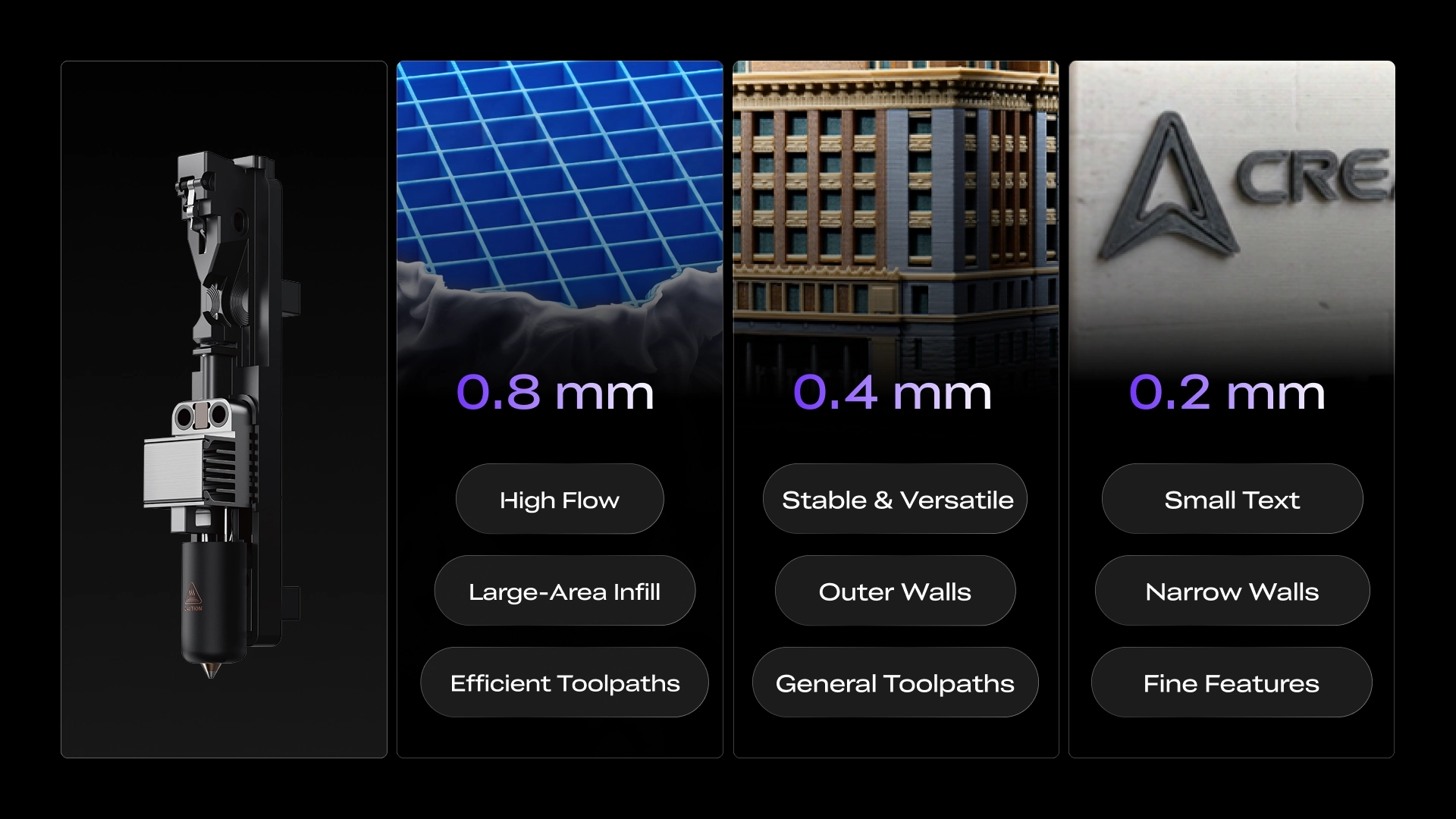
K3 adds another variable that QuarTeks™ does not need for its primary four-color workflow: nozzle diameter.
The system supports nozzle options including 0.2 mm, 0.4 mm, 0.6 mm and 0.8 mm. This makes it possible to assign different nozzle diameters to different printing tasks.
For example, a smaller nozzle can handle fine text, narrow walls or surface details, while a larger nozzle can print high-volume infill or structural regions more efficiently.
This does not mean that more nozzle changes are automatically better. Every switch introduces some overhead, so the efficiency gain depends on the geometry, amount of toolpath assigned to each nozzle and material combination.
For a deeper technical explanation, see our guide to K3 mixed-nozzle printing.
Two Different Strategies for Reducing Filament Waste
Both systems address one of the biggest limitations of conventional multicolor FFF printing: repeated purging.
QuarTeks™: Minimise the Shared Path

QuarTeks™ brings all four filament channels almost to the nozzle and limits the shared section to less than 1 mm.
- Four colors stay close to the hotend.
- Channel changes occur inside the toolhead.
- Very little filament remains in the shared section.
- Less transition material needs to be flushed.
KliTek™: Separate the Printing Paths
KliTek™ takes the opposite approach by maintaining independent nozzle and filament paths.
- Materials remain physically separated.
- Nozzles can be assigned to different materials.
- Repeated unloading and reloading through one hotend is reduced.
- Different nozzle diameters can be used when the print benefits from them.
The engineering goal is similar, but the methods are fundamentally different:
QuarTeks™ minimises the shared path. KliTek™ separates the printing paths.
Which Workflow Is QuarTeks™ Designed For?
QuarTeks™ is particularly suited to users whose main priority is fast and efficient four-color printing.
Typical applications include:
- multicolor figures and collectibles;
- decorative models;
- toys and visual projects;
- color-coded prototypes;
- batch printing with frequent color changes;
- projects where reducing purge time and filament consumption is important.
The SPARKX i8 combines this architecture with a 260 × 260 × 255 mm build volume, making QuarTeks™ a compact solution for everyday four-color creation.
Note: SPARKX i8 is currently in the crowdfunding phase on Indiegogo.
Which Workflow Is KliTek™ Designed For?
KliTek™ is aimed at workflows where material independence matters as much as color.
Typical applications include:
- functional prototypes;
- rigid-and-flexible parts;
- TPU applications;
- support-material workflows;
- different nozzle diameters within one model;
- engineering and reinforced materials;
- advanced print-in-place designs.
In simple terms, QuarTeks™ optimises four-color printing, while KliTek™ extends multicolor printing into a broader multi-material and multi-nozzle workflow.
Different Architectures, the Same Direction
QuarTeks™ and KliTek™ represent two different solutions to the compromises traditionally associated with multicolor FFF printing.
QuarTeks™ brings four filament channels almost all the way to a single nozzle, prioritising fast switching and low transition waste.
KliTek™ keeps extrusion paths separate and makes the nozzle itself interchangeable, prioritising material independence and greater flexibility over how different parts of a model are printed.
One architecture focuses on speed, simplicity and four-color efficiency. The other focuses on multi-material flexibility, nozzle choice and functional printing.
Rather than competing versions of the same mechanism, they represent two different paths towards more capable multicolor 3D printing.
Frequently Asked Questions
1. Are QuarTeks™ and KliTek™ the same type of multicolor system?
No. QuarTeks™ integrates four filament channels into one toolhead and prints through a shared nozzle. KliTek™ uses independent filament paths and interchangeable nozzle assemblies.
2. Which system switches colors faster?
QuarTeks™ switches its internal filament channel in under one second, while KliTek™ performs a physical nozzle change in approximately 4.8 seconds. These are different mechanical operations, so the numbers should not be treated as a direct comparison of total printer performance.
3. Can KliTek™ also print multiple colors?
Yes. Multicolor printing is a core KliTek™ use case. Its independent nozzle architecture also allows the platform to expand into multi-material, flexible-filament and mixed-nozzle workflows.
4. What is the main advantage of QuarTeks™?
Its main advantage is fast four-color switching through a simple single-toolhead architecture, combined with an ultra-short shared filament path that reduces transition waste.
5. What is the main advantage of KliTek™?
KliTek™ physically separates extrusion paths and supports interchangeable nozzle assemblies, providing more flexibility for multi-material printing, TPU and different nozzle diameters.
Recent News

Latest 3D Printing Technology in 2026: 8 Practical Innovations

24 Cool Stuff to 3D Print - Fun & Useful 3D Print Ideas
