


Wet filament can show up as popping from the nozzle, extra stringing, bubbles, rough surfaces or inconsistent extrusion. A dedicated filament dryer is the most convenient way to control heat and airflow, but it is not the only option. If you are wondering how to dry filament without a dryer, a carefully monitored household oven or a dedicated food dehydrator can work for some materials.
The important part is not simply “adding heat.” You need the correct temperature for the exact filament, enough time, moisture removal, and a spool that can tolerate the drying temperature. Household ovens can overshoot at low settings, and even a correct filament temperature can deform a heat-sensitive spool.
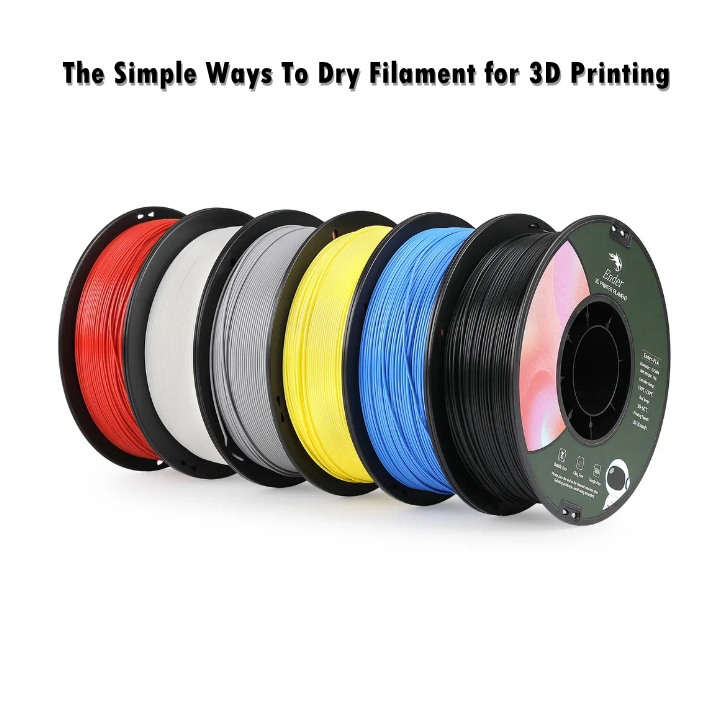
Quick Answer: Can You Dry Filament Without a Filament Dryer?
Yes, but only when the alternative appliance can safely hold the filament manufacturer's required temperature. A food dehydrator is usually the better DIY option because it is designed to move warm air and release moisture. A household oven is less predictable at the low temperatures used for PLA and PETG.
| Method | Good For | Main Risk | Best Practice |
|---|---|---|---|
| Household oven | Materials whose drying temperature is within a verified stable oven range | Temperature overshoot and spool deformation | Measure actual temperature with an independent thermometer before inserting filament |
| Food dehydrator | PLA, PETG and other materials within the appliance's real temperature range | Limited maximum temperature and uneven chamber temperature | Use a unit dedicated to plastics and verify temperature around the spool |
| Passive dry box | Keeping already-dry filament dry | Too little heat to recover wet filament quickly | Use it for storage or print-through humidity control |
| Dedicated filament dryer | Repeatable drying and printing directly from the box | Temperature ceiling varies by model | Choose a model that reaches the temperature required by your hottest material |
Start With the Filament Manufacturer's Temperature
Do not use one drying temperature for every PLA, PETG or Nylon spool. Additives, fiber reinforcement and spool construction can change the safe setting. Creality's official filament guidance recommends checking the exact manufacturer's drying instructions first and also warns that the spool can deform or melt when drying temperature exceeds its heat resistance.
Creality's general dryer reference lists 55°C for PLA/PLA-CF, 60°C for PETG, 65°C for ABS/ASA and 70°C for TPU, generally for 8–12 hours in a Creality filament dryer. PA, PA-CF, PC and other engineering materials may need hotter equipment. For a broader overview, read the Creality filament dryer guide.
Drying temperature is not nozzle temperature. Never copy a slicer nozzle setting into an oven or dehydrator.
Method 1: How to Dry Filament in an Oven
A household oven is convenient, but it is the method that deserves the most caution. Prusa's official drying guidance warns that home ovens often have imprecise low-temperature control: fluctuations that do not matter for cooking can damage low-temperature filament such as PLA, and many ovens cannot be set low enough to dry filament safely.
- Confirm the exact drying temperature from the filament maker.
- Check spool heat resistance.
- Preheat and test the empty oven. Place an independent probe where the spool will sit and record the minimum and maximum for 20–30 minutes.
- Stop if it overshoots the filament or spool limit.
- Keep the spool away from heating elements and allow normal air exchange.
- Use the specified drying time. Do not compensate for excessive heat by shortening the cycle.
Prusa specifically recommends an external thermometer because a conventional oven's displayed setting may not match the real low-temperature chamber condition.
Method 2: Use a Food Dehydrator
A food dehydrator can be a better alternative because the basic design already combines gentle heat, airflow and vents that remove humid air. Prusa notes that dehydrators can be adapted by removing trays so a spool fits, but many models have relatively low maximum temperatures. That makes them more suitable for lower-temperature materials than for PA, PC or other engineering filaments that require hotter drying.
Verify the real chamber temperature with a probe near the spool. If possible, check more than one height because heater and fan location can create temperature differences. If the unit cannot reach the manufacturer's target safely, use another method.
Food-safety note: dedicate a repurposed dehydrator to plastics and do not switch it back to food use. Snapmaker's current filament-drying guidance gives the same recommendation.
Why Venting Moist Air Matters
Heating raises the filament temperature so absorbed water can migrate out, but the moisture still needs somewhere to go. A sealed warm container with no meaningful air exchange can hold humid air around the spool and slow the process. That is why food dehydrators use airflow and vents, professional drying ovens use controlled exhaust, and higher-end filament dryers add active moisture removal.
Prusa's professional drying-oven workflow uses an adjustable exhaust flap to balance temperature stability and humidity removal. The same principle applies to DIY setups: controlled warm airflow is better than a hot sealed box.
A passive storage box is different from an active dryer. Dry wet filament first, then use a dry box or sealed bag to slow re-absorption. See Creality's filament dry box and storage guide.
How to Test an Oven or Dehydrator Before Trusting It
Instead of assuming the dial is accurate, run a simple empty-chamber test:
- Set the appliance to the intended drying temperature.
- Place temperature probes near the top, center and bottom of the spool area if you have multiple sensors.
- Record readings every five minutes for 30 minutes after warm-up.
- Write down the lowest, highest and average temperature.
- Repeat with a spool that you can afford to test, watching the flanges and hub for bowing or distortion.
This separates three numbers that drying guides often blur together: target temperature, actual chamber temperature and time at useful temperature. Creality notes that the two chambers in SpacePi X4 can temporarily differ by about 1–5°C during heating at the same target, showing why a setpoint is not the temperature everywhere in a chamber.
When You Should Stop Using DIY Drying Methods
An oven or dehydrator is not the right solution for every spool. Move to purpose-built equipment when:
- Your oven cannot hold the required low temperature without overshooting.
- The material needs more heat than the dehydrator can provide.
- You regularly print TPU, PA, PA-CF, PC or other moisture-sensitive materials.
- You need to keep filament dry while printing.
- You dry filament frequently enough that repeated thermometer checks become impractical.
- You need multiple spools ready at once.
For one spool, the Creality Space Pi Filament Dryer provides 45–70°C adjustment, up to 48 hours, humidity monitoring and 360° PTC hot-air circulation. The two-spool Space Pi Plus uses the same temperature class with dual-roll capacity.
For hotter or four-spool workflows, SpacePi X4 reaches 85°C and adds dual independent chambers plus active dehumidification. Compare current options in Best Filament Dryer 2026 or the filament dryer collection.
How to Tell Whether Drying Worked
Print the same small test before and after drying without changing nozzle temperature, retraction or speed. Look for reduced popping, fewer bubbles, cleaner surfaces and less unexplained stringing.
If the print does not improve, moisture may not be the main problem. Check extrusion, temperature and retraction before running another long cycle. Once dry, store the spool in a sealed container or dry box with desiccant.
For more options, see Creality Filament Dryers Compared and the SpacePi X4L guide.
FAQ
Can I dry PLA without a filament dryer?
Yes, if you have an appliance that can hold PLA's manufacturer-approved drying temperature without overshooting. A household oven should be verified with an independent thermometer before the spool goes in.
Is a food dehydrator better than an oven for filament?
Often, because dehydrators are designed around warm airflow and moisture exhaust. However, many cannot reach the temperatures required by Nylon, PC or high-performance composites. Verify both temperature range and chamber uniformity.
Can I use the same food dehydrator for filament and food?
It is better to dedicate the appliance to filament once it has been used for plastics. This avoids mixing food preparation with residues, dust, colorants or additives from filament and spools.
When is a dedicated filament dryer worth it?
It becomes worthwhile when you dry frequently, print moisture-sensitive materials, need print-through drying, cannot verify a kitchen appliance's low-temperature stability or need higher temperatures and multiple spool capacity.
Bottom Line: DIY Drying Works Only When You Can Control the Variables
You can dry filament without a dedicated dryer, but only when you can control the variables: manufacturer-approved temperature, real appliance temperature, moisture exhaust, spool heat resistance and enough drying time.
If an oven fluctuates too much, a dehydrator cannot reach the required temperature, or moisture-sensitive materials are routine, move to purpose-built equipment: Space Pi for one spool, Space Pi Plus for two, or SpacePi X4 for four-spool and higher-temperature workflows.


