


What Is the Strongest 3D Printer Filament in 2024
3D printing can be incredibly fun, but often the parts produced are too weak for practical use. This is usually due to using standard materials that aren't built for strength and endurance. The solution? Use strong filaments!
Selecting the strongest filament for your specific application is critical for ensuring durability and performance.In this article, we’ll explore four of the strongest filaments available for average 3D printers.
What Does Strength in 3D Printer Filaments Mean?
Strength in 3D printer filaments can be measured in several ways. For this article, we'll primarily focus on tensile strength and elongation at break.
- Tensile Strength: This tells us how much force a material can resist before breaking when pulled apart at both ends. It's measured in PSI or MPa.
- Elongation at Break: This describes how much a material stretches (in % of its original length) before breaking, indicating its stiffness.
For certain applications, a material’s ability to bend and then return to its original shape without breaking (impact resistance) is crucial. When designing a part, consider if it should be completely rigid or flexible under force; this will guide your material choice.
Other Critical Strength Metrics
- Flexural Strength: Resistance to fracture or distortion under bending forces.
- Shear Strength: Resistance to fracture or deformation under shear loads.
- Compressive Strength: The ability to withstand crushing forces.
- Abrasion Resistance: Surface resistance to spalling or grinding.
- Fatigue Resistance: Tolerance to cyclic loading.
- Tear Strength: Resistance to tearing forces.
- Heat Resistance: Ability to retain properties at elevated temperatures.
- Creep Resistance: Dimensional stability under prolonged loading.
- Chemical Resistance: Maintenance of properties when exposed to harsh chemicals or UV light.
The Strongest Filaments for Desktop 3D Printers in 2024
Here is a summary of the best Strongest 3D Printer Filaments you can use for printing.
Polycarbonate (PC)
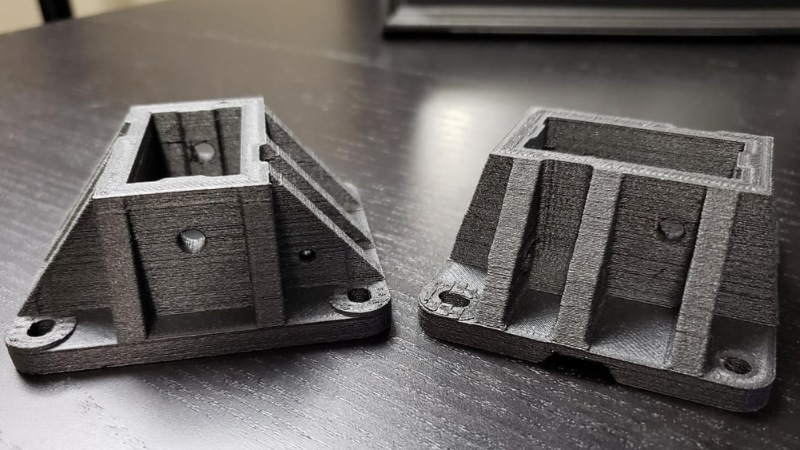
Polycarbonate (PC) is revered as the pinnacle of strength in the consumer 3D printing market, revered for its robustness and high-performance capabilities. Renowned for creating parts that exhibit extraordinary strength and durability, PC is the go-to filament for applications requiring superior mechanical properties. Despite its many advantages, polycarbonate requires careful handling and specific printing conditions to achieve optimal results. Ideal for functional prototypes and end-use components, the PC offers unmatched tensile strength, making it a top choice for engineers and professionals in various industries.
- By the Numbers: Tests have shown that a PC hook can support up to 685 lbs (311 kg) and has a tensile strength of 9,800 PSI (67.5 MPa). PC carabiners also withstand more weight than those made from PLA, PETG, ABS, or nylon.
- Toughness: It outperforms most other filaments in durability tests, including MatterHackers' carabiner strength test, in which a PC carabiner held 409 lbs (186 kg) before breaking.
- Printing Requirements: Requires high printing temperatures and an enclosed environment to minimize warping and effectively handle overhangs or fine details.
- Color Availability: It is typically available in primary colors such as transparent, black, or white, reflecting its utility-focused application range.
- Special Equipment Needed: Best printed with an all-metal hot end and a printer capable of maintaining a stable, high-temperature environment to ensure the material properties are fully realized.
- Pros: Very strong, heat-resistant up to 100°C, durable.
- Cons: Hard to print, requires an enclosure and all-metal hot end, limited colors.
Nylon
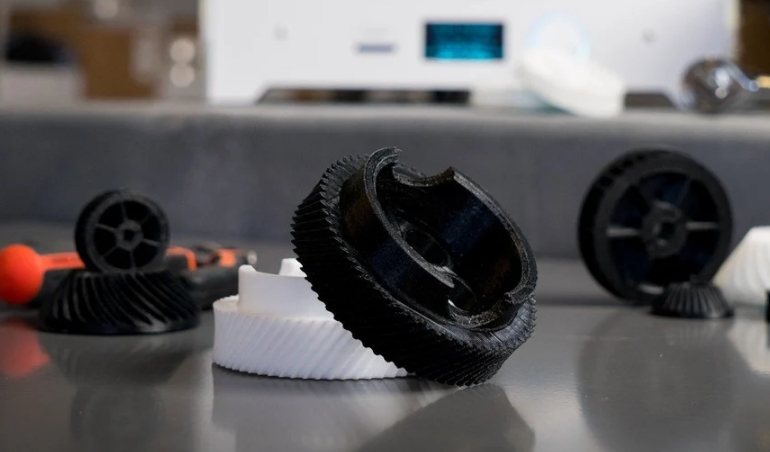
Nylon is a highly versatile and robust filament widely used in 3D printing for its balance of strength and flexibility. It surpasses many traditional materials like PLA and ABS in toughness and thermal resistance, making it ideal for functional parts requiring resilience and durability. Nylon comes in various types, each suited to different applications, offering multiple melting points and resistance characteristics. This material is particularly prized for its ability to produce sturdy yet slightly flexible components that withstand wear and environmental factors.
- By the Numbers: Demonstrates considerable strength in load-bearing tests, with Taulman’s Alloy 910 nylon supporting up to 485 pounds (220 kg) and boasting a tensile strength of 7,000 PSI (48 MPa).
- Strength Varieties: This includes nylon 6, 66, and 12, each tailored for specific properties such as ease of processing, heat resistance, and moisture resistance.
- Printing Demands: This requires precise printing conditions, such as high temperatures and an enclosed printing environment, to combat issues like warping and poor bed adhesion.
- Moisture Sensitivity: Highly resistant to moisture absorption, especially nylon 12, which ensures stable properties over time and use.
- Application Flexibility: Suitable for a wide range of applications from industrial parts to consumer goods due to its durability and slight flexibility.
- Pros: Impact and fatigue resistant, heat-resistant up to 80°C, easier to print than PC.
- Cons: Hygroscopic, warps, requires high temperatures.
TPU
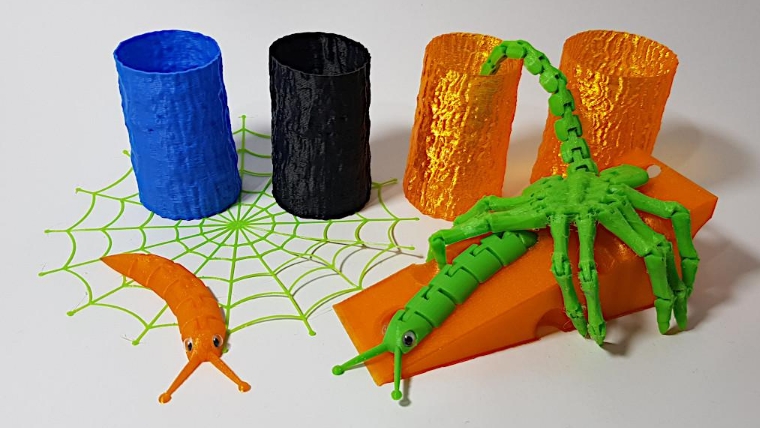
TPU is celebrated for its elasticity and impact resistance, making it an excellent choice for highly flexible and durable objects. Unlike rigid filaments, TPU can withstand bending and stretching without losing its form or breaking. It is ideal for many practical applications, including protective and wearable components. Its unique properties allow it to absorb impacts effectively, providing cushion and resistance where needed.
- By the Numbers: Wolfblend TPU stretches up to 909% of its original length and has a tensile strength of 23.8 MPa. Its elongation before break is significantly higher than PLA or nylon.
- Flexibility and Elasticity: Exhibits high elongation at break, with Airwolf 3D's Wolfblend TPU stretching up to 909% of its original length before failing.
- Applications: Ideal for parts requiring high impact resistance and elasticity.
- Challenges: TPU can easily clog printer nozzles and must be printed slowly. It costs $30-$60 per kg at 1.75 mm diameter.
- Printing: TPU is difficult to print, especially with a Bowden extruder. A direct drive extruder is recommended.
- Pros: Impact-resistant, flexible, standard temperature requirements.
- Cons: Not rigid, best with direct drive extruders, slow printing speeds.
The Strongest 3D Printer Filaments in 2024
PEEK (Polyether Ether Ketone)
PEAK leads the 3D printing filament market in terms of strength and versatility.
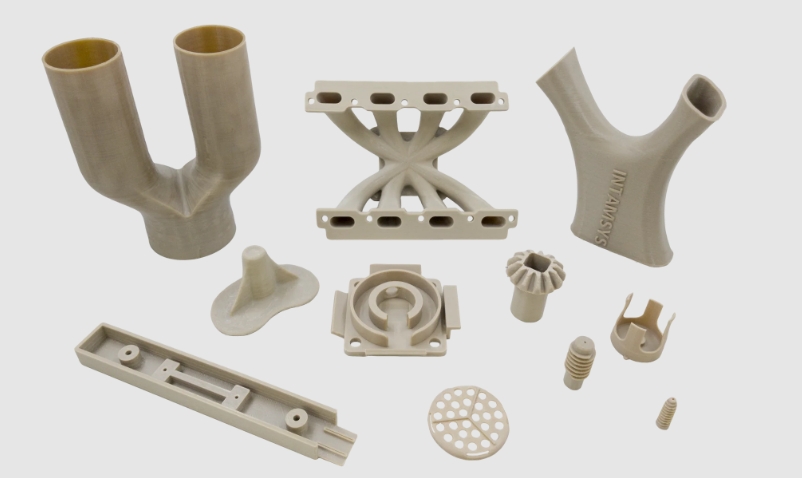
- Strength and Durability: PEEK stands out with exceptional tensile strength (over 90 MPa), high heat resistance (up to 360°C), and excellent chemical resistance. It's perfect for aerospace, automotive, medical devices, and even components subjected to harsh mechanical environments.
- Applications: Aerospace, automotive sector, electrical and electronic industry.
PEI
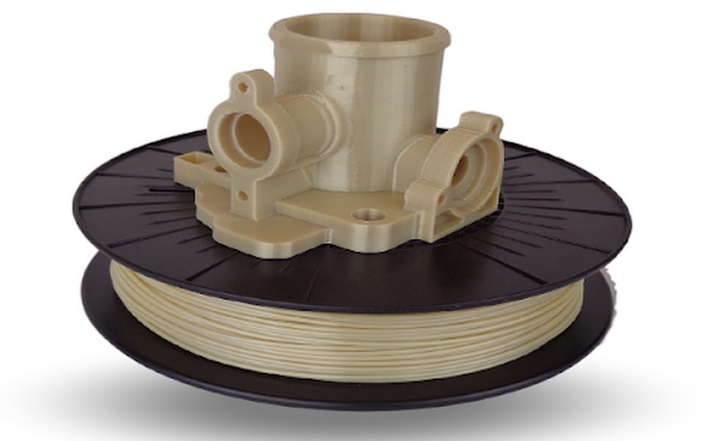
PEIs are hailed for unstinting mechanical performance in harsh environments.
- Thermal Stability: With high thermal stability and good flame resistance, PEI is excellent for electrical components and industrial applications.
- Benefits: PEI demonstrates strong resistance to heat (operating up to 217°C continuously), making it valuable in sectors such as aerospace where high performance in extreme conditions is crucial.
- Cost and Implementation: Although costlier and challenging to use compared to standard filaments, Ultem's performance justifies its price in demanding applications.
Carbon-Fiber-Infused Nylon
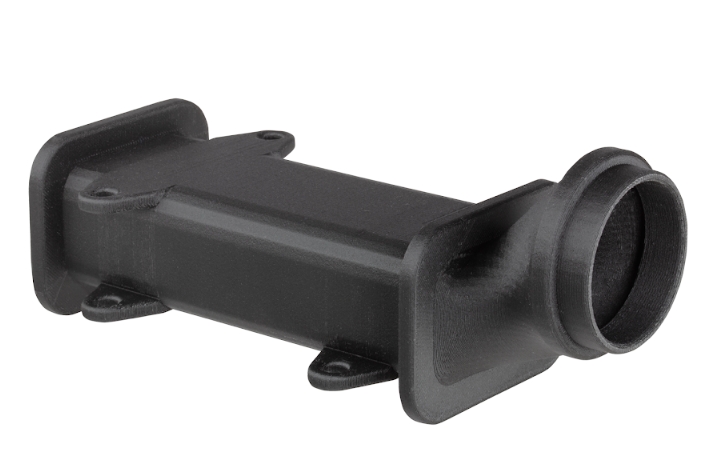
Combining the flexibility of nylon with the rigidity of carbon fiber provides a solid, strong filament suitable for various practical uses.
- Strength-to-Weight Ratio: This filament blends the flexibility of nylon with the stiffness of carbon fibers, yielding superior tensile strength (up to 105 MPa depending on the formulation) and reduced weight.
- Versatility and Application: Particularly popular in automotive and drone applications, where weight reduction without compromising strength is critical.
Read more: Exploring the Potential of Carbon Fiber in 3D Printing
PEEK vs. PEI vs. Carbon-Fiber-Infused Nylon
Tensile Strength
- PEEK: >90 MPa
- PEI: Approximately 105 MPa
- Carbon-Fiber Nylon: Up to 105 MPa (variant dependent)
Heat Resistance
- PEEK: Up to 360°C
- PEI: Around 217°C continuous use
- Carbon-Fiber Nylon: Varies (often up to 120°C)
Chemical Resistance
- PEEK: Excellent
- PEI: Very good
- Carbon-Fiber Nylon: Good
Ease of Printing
- PEEK: Requires high-temperature heated bed and nozzle
- PEI: Needs controlled environment and high temperatures, but easier compared to PEEK
- Carbon-Fiber Nylon: More accessible with moderate printing environments
In Conclusion
Choosing the strongest 3D printer filament depends on the specific application, expected loading, and design considerations. Carbon fiber reinforced nylon, polycarbonate, and PEI stand out for their exceptional properties.
However, understanding your printer’s capabilities and practicing with these materials is crucial. This guide should help you navigate the choices for creating durable and high-performance 3D-printed parts.

Recent News

8 Halloween 3D Print Ideas to Make Before October 31

Ender Series 3D Printers Parameter Comparison

Creality Back-to-School Sale 2026: Save Up to 50% on 3D Printers and More
