


Comparative Buying Guide: Detailed Breakdown of Ender-3 V2, Ender-3 Neo, Ender-3 V2 Neo
In August 2022, Creality introduced the Ender 3 V2 Neo, a noteworthy addition to the Ender 3 series, which includes the Ender 3, Ender 3 V2, and the newly launched Ender-3 Neo. As a popular choice among budget 3D printing enthusiasts, the original Ender 3 V2 boasts a substantial community. The Ender 3 V2 Neo maintains key features from its predecessor while incorporating upgrades for enhanced performance, durability, user-friendliness, and print accuracy. Notable improvements include an upgraded mainboard, auto bed leveling system, all-metal extruder, and a metal build plate.
Today, we'll compare the Ender 3 V2 Neo with both its predecessor, the Ender 3 V2, and the Ender-3 Neo, providing insights into whether the enhancements justify the price difference.
Note: As of a recent update in late 2023, we launched the Ender 3 V3 SE and Ender 3 V3 KE, both of which we strongly suggest choosing over the Ender 3 V2 or the V2 Neo. For a more comprehensive understanding, kindly refer to our comparison of Ender 3 V3 SE and Ender 3 V3 KE.
| Ender 3 V2 | Deal Price: $175 (Original Price: $279) | Buy | |
| Ender-3 Neo | Deal Price: $179 (Original Price: $219) | Buy | |
| Ender-3 V2 Neo | Deal Price: $269 (Original Price: $299) | Buy |
Comparison of Ender-3 V2, Ender-3 Neo, Ender-3 V2 Neo

Differences between Ender-3 V2, Ender-3 Neo, Ender-3 V2 Neo:
| Model | Ender-3 V2 | Ender-3 Neo | Ender-3 V2 Neo |
| Release Date | 2020.5 | 2022.8 | 2022.7 |
| Build Volume (mm) | 220*220*250 | 220*220*250 | 220*220*250 |
| Product Dimensions (mm) | 475*470*620 | 440*440*465 | 438*424*472 |
| Package Dimensions (mm) | 555*380*200 | 500*380*216 | 520*505*280 |
| Net Weight (kg) | 7.8 | 7 | 7.8 |
| Gross Weight (kg) | 9.3 | 8.9 | 9.8 |
| Extruder | Bowden Exturder | Bowden Exturder | Bowden Exturder |
| Supported Filaments | PLA, PETG, TPU | PLA, PETG, ABS | PLA, PETG, ABS |
| Build Surface | Carborundum Glass Plate | Carborundum Glass Plate | PC Spring Steel Sheet + Magnetic Base |
| Display Screen | 4.3" Color Screen with Rotary Knob | 12864 Monochrome Screen with Rotary Knob | 4.3" Color Screen with Rotary Knob |
| Power Loss Recovery | √ | √ | √ |
| Filament Runout Sensor | X | X | X |
| Dual Z-axis | X | X | X |
| Auto Leveling | X | √ (CR-Touch) | √ (CR-Touch) |
| Auxiliary Leveling | √ | √ | √ |
| Data Bus Width | 32-bit | 32-bit | 32-bit |
| Silent Mainboard | √ | √ | √ |
| File Transfer | TF Card, USB Cable | USB Cable/TF Card | TF Card, USB Cable |
| Max. Heatbed Temperature | 100℃ | 100℃ | 100℃ |
| Max. Nozzle Temperature | 260℃ | 260℃ | 260℃ |
| Rated Voltage | 100-120V~, 200-240V~ | 100-120V~, 200-240V~ | 100-120V~, 200-240V~ |
| Rated Power | 350W | 350W | 350W |
| Max. Printing Speed | 100mm/s | 120mm/s | 120mm/s |
| Typical Printing Speed | 50mm/s | 50mm/s | 50mm/s |
| Power Input Frequency | 50/60Hz | 50/60Hz | 50/60Hz |
| Output Voltage | 24V | 24V | 24V |
| Printing Technology | FDM | FDM | FDM |
| Extruder Count | 1 | 1 | 1 |
| Nozzle Diameter | Standard 0.4mm | Standard 0.4mm | Standard 0.4mm |
| Layer Height | 0.1-0.4mm | 0.1-0.35mm | 0.1-0.35mm |
| Printing Accuracy | ±0.1mm | ±0.1mm | ±0.1mm |
| Filament Diameter | 1.75mm | 1.75mm | 1.75mm |
| File Formats | STL, OBJ, AMF | STL, OBJ, AMF | STL, OBJ, AMF |
| Slicing Software | Creality, Cura, Repetier-Host, Simplify3D | Creality slicer, Cura, Simplify3D | Creality, Cura, Simplify3D |
| Current Price |
$175 |
$179 |
$269 |
Note: The price displayed is subject to fluctuations and is for reference purposes only; kindly check the actual price on the date of placing your order.
Ender-3 V2
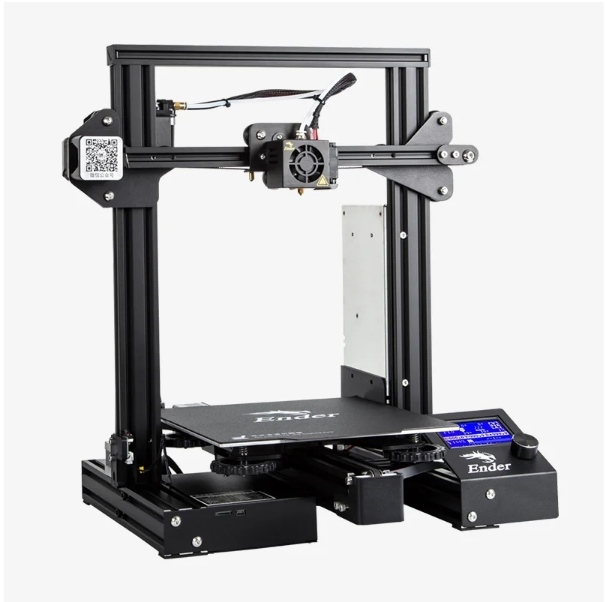
The Ender-3 V2 was released in May 2020, boasting a 220x220x250mm build volume. With product dimensions of 475x470x620mm and a package size of 555x380x200mm, it has a net weight of 7.8kg and a gross weight of 9.3kg. The V2 utilizes a Bowden exturder and supports PLA, PETG, and TPU filaments.
It features a Carborundum Glass Plate build surface and a 4.3" color screen with a rotary knob for easy control. It also comes with power loss recovery and auxiliary leveling, although it lacks filament runout sensor and dual Z-axis. The V2 operates on a 32-bit data bus width and includes a silent mainboard.
The V2 model supports file transfer through a TF Card or a USB Cable, with a maximum heatbed temperature of 100℃ and a maximum nozzle temperature of 260℃. The printer operates at a rated power of 350W, with a rated voltage of 100-120V~, 200-240V~. It boasts a maximum printing speed of 100mm/s and a typical printing speed of 50mm/s.
Pros
- Carborundum Glass Plate build surface.
- 4.3" color screen with rotary knob.
- TF Card/USB Cable file transfer.
- Power loss recovery, auxiliary leveling.
- Max heatbed temp: 100℃, nozzle temp: 260℃.
- Silent mainboard.
Cons
- No filament runout sensor, dual Z-axis.
Ender-3 Neo
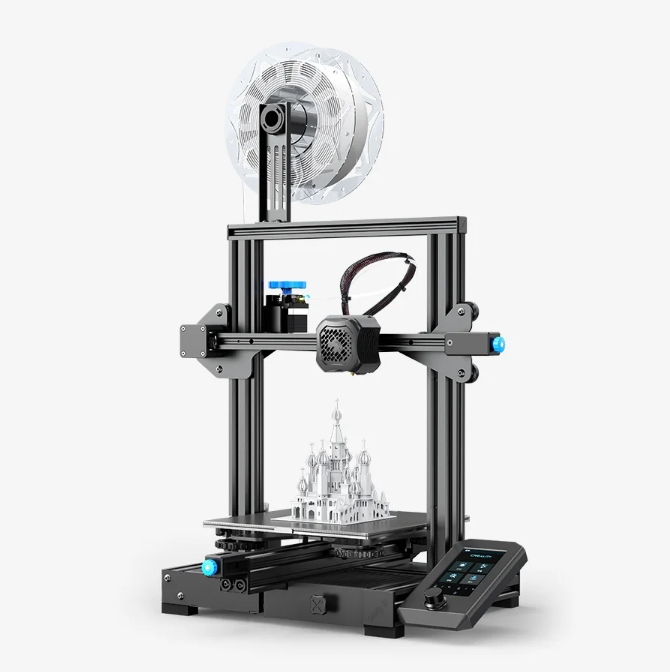
The Ender-3 Neo, released in August 2022, shares the same build volume as the V2, but with slightly smaller overall dimensions. It utilizes a 12864 Monochrome Screen with a rotary knob and supports PLA, PETG, and ABS filaments.
The Neo also includes auto leveling with the help of CR-Touch. Unlike the V2, the Neo supports file transfer through a USB cable or TF card. It also comes with a Carborundum Glass Plate build surface and boasts a maximum printing speed of 120mm/s.
Pros
- Smaller dimensions.
- Supports PLA, PETG, ABS.
- Auto leveling with CR-Touch.
- Faster max printing speed: 120mm/s.
Cons
- 12864 Monochrome Screen.
Ender-3 V2 Neo

The Ender-3 V2 Neo, released in July 2022, mirrors the specifications of the Neo but with some slight differences. It comes with a PC Spring Steel Sheet plus a Magnetic Base build surface, providing an extra layer of convenience for users. It also includes a 4.3" color screen with a rotary knob and supports PLA, PETG, and ABS filaments.
All three models use FDM printing technology, with a standard 0.4mm nozzle diameter and a layer height of 0.1-0.4mm for the V2 and 0.1-0.35mm for the Neo and V2 Neo. All three models have a printing accuracy of ±0.1mm and use a 1.75mm filament diameter. They all support STL, OBJ, and AMF file formats and are compatible with Creality, Cura, and Simplify3D slicing software.
Pros
- PC Spring Steel Sheet + Magnetic Base build surface.
- 4.3" color screen with rotary knob.
- Supports PLA, PETG, ABS.
- Layer height range: 0.1-0.35mm.
Cons
- Mirrors Neo specs, limited new features.
- Community support.
Ender-3 V2, Ender-3 Neo, Ender-3 V2 Neo Buying Guide
When choosing between the Ender-3 V2, Neo, or V2 Neo, your personal needs and preferences are the determining factors. Here are some factors to consider:
- Filament Types: All three models support PLA and PETG, but only the Neo and V2 Neo support ABS. If you plan to print with ABS, then the Neo or V2 Neo would be the best choice.
- Screen Type: If you prefer a color screen, then the V2 or V2 Neo would be the best choice. If a monochrome screen is sufficient for your needs, then the Neo would be a good choice.
- Auto-Leveling: If you value the convenience of automatic bed leveling, then the Neo and V2 Neo would be the best choice as they come with a CR-Touch.
- Build Surface: The V2 and Neo models have a Carborundum Glass Plate, whereas the V2 Neo has a PC Spring Steel Sheet plus a Magnetic Base. Consider your preference and choose accordingly.
- Printing Speed: The Neo boasts the fastest printing speed of 120mm/s. If speed is a crucial factor for you, then the Neo would be the best choice.
As for purchase recommendations, all three models are solid choices depending on your needs. The Ender-3 V2 provides a good balance between price and functionality. The Ender-3 Neo is the most recent model and offers the fastest printing speed and support for ABS filament. The Ender-3 V2 Neo offers the most convenience with its magnetic base and PC spring steel sheet.
When purchasing, ensure to verify the package contents for all components and accessories. Also, remember that while these printers are designed for easy assembly, some technical proficiency is required to ensure proper setup and operation. Lastly, always purchase from a trusted seller or directly from Creality to ensure you receive genuine products.
Also Read:
Comparative Analysis: Creality Ender 3 Pro, Ender 3 V2, Ender 3 S1, Ender 3 S1 Pro, V3 KEHow a 3D Printer Works
Conclusion
In conclusion, the Ender-3 V2, Ender-3 Neo, and Ender-3 V2 Neo each bring their unique strengths to the table, offering users variety and functionality in their 3D printing endeavors. Whether you're a beginner or a seasoned professional, these 3D printers are designed to cater to your creative needs.
Recent News

8 Halloween 3D Print Ideas to Make Before October 31

Ender Series 3D Printers Parameter Comparison

Creality Back-to-School Sale 2026: Save Up to 50% on 3D Printers and More
