



Sermoon D3 Pro: Dual Extrusion, Versatile & Efficient
【Dual-filament Printing: Reliable Dual Extrusion with High Flow】
【Auto XYZ Offset of the 2nd Hotend】
【300mm/s* Speed, Quick to Fulfill Orders】
【Diverse Filaments for Broad Applications】
【Stay Auto-leveled for a Long Time】
【Thermostatic Chamber to Forge Robust Print】
Multicolor 3D Printer: Exploring the Possibilities of Multi-Color 3D Printing
all
2024-12-23 05:05:12
Previously, 3D printing was primarily a monochromatic production method, limiting users from creating rich, multi-coloured models. In recent years, multi-colour 3D printing has revolutionized the way we create and personalize objects, allowing complex designs to be created using multiple colours in a single print. This advanced technology enhances the beauty and functionality of 3D printed objects, making it a popular choice for hobbyists, designers and professionals seeking vibrant and sophisticated prints.
3D Printing Market Trend In the Future
The Wohlers Report 2024 reveals that the 3D printing industry has surpassed $20 billion, highlighting significant growth and adoption across various sectors. The report emphasizes advancements in technology, increased production capabilities, and the expanding applications of 3D printing, projecting continued robust growth in the coming years.
Multicolour 3D printing has emerged from a rapidly growing market trend that has seen significant expansion in recent years. This growth is being driven by technological advances and the increasing demand for intricate, visually appealing products. Innovations in multicolour filaments and printers have made the technology more accessible and versatile, increasing its adoption across different sectors.
Multi-Color Filament
Multi-color filaments are specially designed 3D printing materials that contain multiple colors within a single spool. These filaments enable 3D printers to produce objects with varying colors without needing to pause the print to switch filaments.
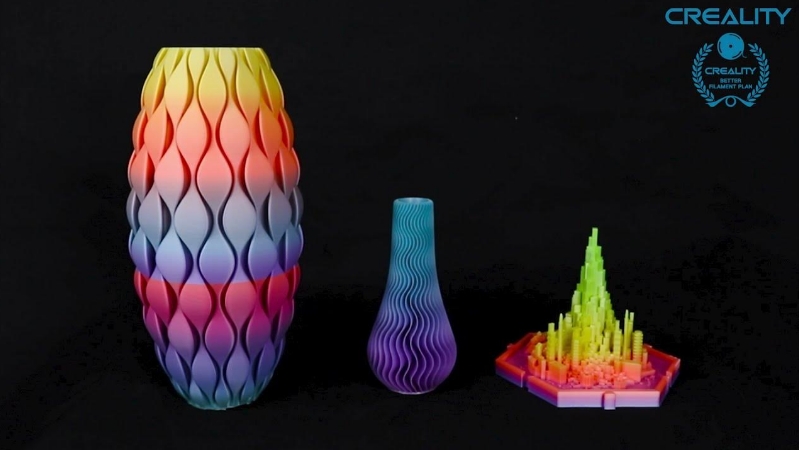
Types of Multi-Color Filaments Available
Gradient Filaments: These filaments gradually transition from one color to another along the length of the spool, creating a smooth gradient effect in printed objects.
Rainbow Filaments: Similar to gradient filaments, but with a series of distinct color changes that cycle through a rainbow spectrum, producing vibrant, multi-colored prints.
Dual-Color Filaments: Filaments that are split into two distinct colors, allowing for prints with a clear division between the two hues.
Tri-Color Filaments: These filaments include three colors, either blended or segmented, providing even more variety in the printed output.
Check out Creality CR-Silk 1.75mm PLA 3D Printing Filament 1kg to see if it meets your needs. Gradient colours include golden red, dual colour includes yellow-blue, pink-purple, golden-silver, blue-green, we also have the rainbow filaments.
Advantages of Using Multi-Color Filament
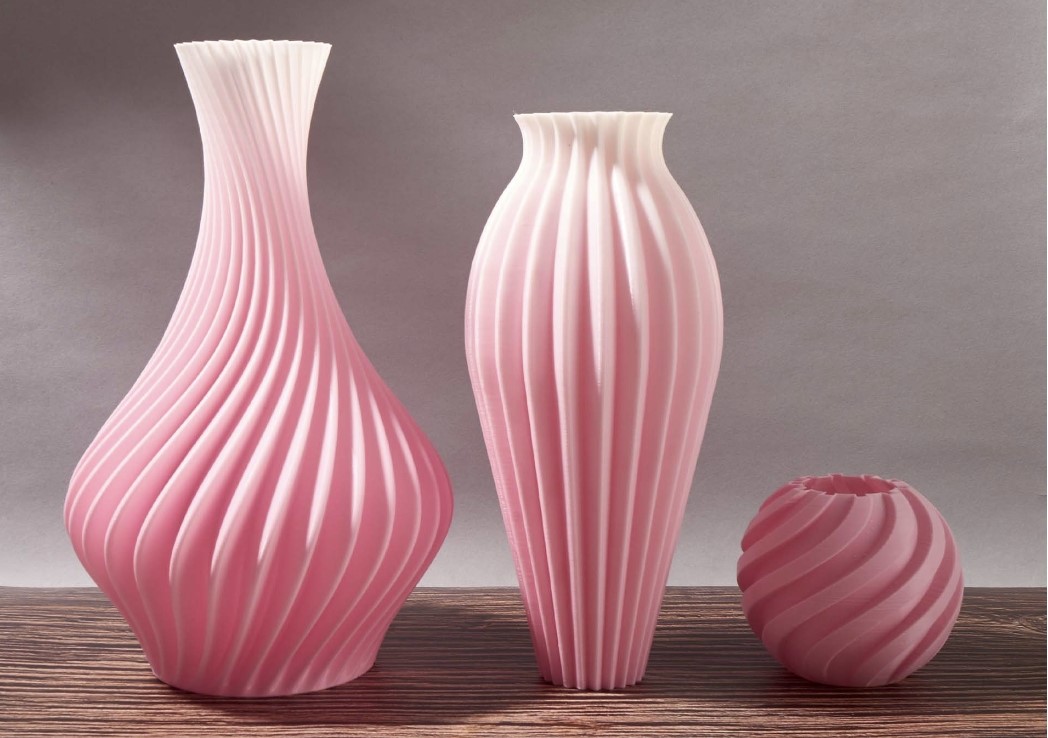
Aesthetic Appeal: Multi-color filaments enable the creation of visually stunning prints with smooth transitions and vibrant color combinations.
Efficiency: They eliminate the need for manual filament changes during the print, saving time and reducing the risk of errors.
Innovation: They open up new possibilities for creative and functional designs, especially in fields like art, education, and product prototyping.
Accessibility: With the development of advanced multi-color filaments, even basic 3D printers can produce complex multi-color prints, making this technology more accessible to hobbyists and professionals alike.
Multicolor 3D Printer
Multicolor 3D printers have revolutionized additive manufacturing by enabling the production of intricate, colorful designs in a single print. Unlike traditional 3D printers that only handle one color at a time, these advanced machines can manage multiple filaments simultaneously. They are perfect for creating detailed, vibrant prototypes, educational models, and artistic pieces.
Separate Color FDM Printers
Color separation FDM 3D printing is one of the simplest methods for achieving multi-color prints. In this technique, each color in a multi-color 3D print is assigned a separate filament. The Creality Sermoon D3 Pro is an upgrade of the Sermoon D3, designed specifically for industrial applications. It features a single-side nozzle lift system for swift and reliable extrusion switching. The printer is equipped with dual hot ends that support dual filament printing, sharing a single extruder. It can handle high flow rates up to 32mm³/s and reach print temperatures of up to 300°C, making it ideal for a variety of complex and demanding projects.
NotebookCheck highlight the printer's robust features, including automatic XYZ offset for the second hotend, a flexible heated printing plate, and a fully enclosed chamber. The D3 Pro supports various filaments like PLA, PETG, and ABS, making it a versatile choice for both hobbyists and professionals.
Sermoon D3 Pro 3D Printer
RFID Tech Multicolor 3D Printer
RFID (Radio-frequency identification) uses electromagnetic fields to automatically identify and track tags attached to objects. An RFID system consists of a small radio transponder, known as a tag, along with a radio receiver and transmitter. When an RFID reader emits an electromagnetic interrogation pulse, the tag responds by transmitting digital data, typically an identifying inventory number, back to the reader. This information can then be used to track inventory items.
Creality and BambuLab have incorporated RFID technology into their automatic consumable management systems, known as the Creality Filament System (CFS) and Bambu Lab's Automatic Material System (AMS). These systems are designed to work with specific printers, enabling the creation of vibrant, multi-color models with ease and precision.
K2 Plus & CFS Multicolor 3D Printer
The Creality K2 Plus, launched during Creality's 10th anniversary, is a versatile multicolor 3D printer. It boasts advanced features for seamless color transitions and high-precision printing, making it ideal for creating detailed, vibrant models. This printer exemplifies Creality's commitment to innovation and quality in the 3D printing industry. More information about K2 Plus,click Creality K2 Plus * CFS Multi-Color Printing Revolution
Creality K2 Plus Combo 3D Printer
 【Multi-Color Printing: Supports Up to 16 Colors Using 4 CFS】
【“Apus” Dual-gear Direct Drive Extruder】
【600mm/s* Printing Speed, ≤30000mm/s² Acceleration】
【FOC Closed-Loop Servo Motors】
【350*350*350mm Big Build Volume】
【Tilt Detection: equipped with two AI cameras】
【Active Chamber Heater: ≤60℃ 】
Prusa i3 MK3S+
The Prusa i3 MK3S+ with the Multi-Material Upgrade 2S (MMU2S) is a versatile 3D printer capable of printing with up to five different filaments simultaneously. Known for its reliability and high-quality prints, it is ideal for complex, multi-color, or multi-material projects.
Ultimaker S5
The Ultimaker S5 is a high-performance 3D printer designed for professional use. It features composite-ready dual extrusion for multi-color and multi-material printing, a large build volume 330 x 240 x 300 mm, and an intuitive touch interface. Known for its reliability and precision, the Ultimaker S5 is ideal for creating complex, high-quality prototypes and end-use parts.
Bambu AMS
The BambuLab Automatic Material System supports up to 16 colors for stunning prints that truly stand out. It keeps filaments dry and detects runout and winding issues. Compatible with Bambu X1 and P1 Series, it includes AMS filament backup for seamless printing.
Conclusion
Multi-color 3D printing offers enhanced design possibilities and vibrant, complex models. To start, choose a reliable multicolor printer like Creality K2 Plus or Bambu Lab AMS, and experiment with multi-color filaments. Embrace this technology to elevate your projects, whether for professional use or creative hobbies.
Recent News

all
2026-10-13
8 Halloween 3D Print Ideas to Make Before October 31
Halloween is coming, and the candy stash has already suffered a few unexplained disappearances. W...

all
2026-09-18
Ender Series 3D Printers Parameter Comparison
The Creality Ender Series has evolved significantly since the original Ender-3. What began as an ...

all
2026-08-02
Creality Back-to-School Sale 2026: Save Up to 50% on 3D Printers and More
A new school year is a chance to start fresh projects, develop practical skills and turn digital ...

all
2026-05-26
Is PLA Recyclable?
PLA is a biodegradable plastic derived from renewable resources such as corn starch or sugarcane....